
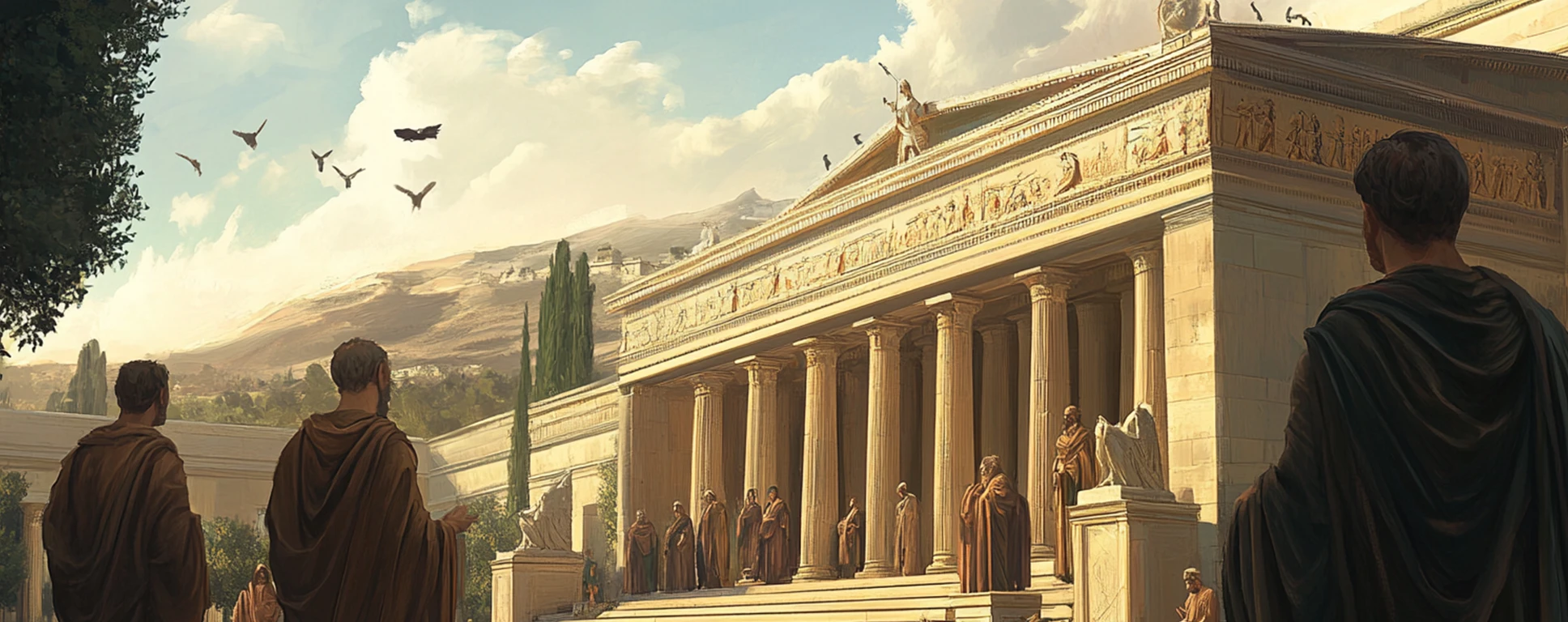
The World of Greek Philosophy
Course Description
This course will serve as an introduction to ancient Greek philosophy and literature of the pre-Classical, Classical, and Hellenistic Greek world, and their conceptions that at once influence and differ from our own. In addition to discussing traditional Greek understandings of virtue, honor, and happiness, we will consider how intellectual life was believed to help people find meaning, purpose,and self-fulfillment and shape their ethics. We will recreate the experience of Greek intellectual culture in simulated marketplace disputations and (nonalcoholic) symposia while reading and discussing works from Pre-Socratics, Plato, Aristotle, Sophocles, Euripides, Euclid, and the Stoics, in an effort to understand not just what but how they thought.
Academic Interest
Humanities (e.g, arts, literature, philosophy)
Application Materials
A complete application includes a transcript, two short essays, a letter of recommendation, writing sample, application fee, and a submitted parent confirmation. If you are seeking need-based financial aid, you must indicate that in your application before it is submitted. Please refer to the Application Instructions for complete details.
Instructor(s)
Arnold Brooks
Other Courses to Consider
These courses might also be of interest.
 The Power of Fantasy: Advanced Critical Writing and Analysis
Is fantasy really just an “escape” from reality, or might it actually provide us new ways of understanding and reimaging our world and our sense of self? From literature and film to the visual and performing arts, fantasy remains one of the most powerful and popular forms. Where does this power come from?
This intensive course in advanced critical writing at the collegiate level will offer you a chance to analyze great works of fantasy, think through these questions, and craft nuanced essays that explore the meaning and power of fantasy.
We will read literary works including stories by Jorge Luis Borges, Ursula K. Le Guin, HP Lovecraft, and Nnedi Okorafor alongside an overlooked but exciting novel by pre-Harlem Renaissance writer Pauline Hopkins; we will watch and discuss films spanning from The Lord of the Rings and Indiana Jones to The Black Panther and Inception; we will analyze visual art, including the imaginary realms of Surrealism; and we will investigate the construction of immersive fantasy spaces, from the highly commercial (like Disneyland) to “alternative” spaces (like Burning Man or Meow Wolf).
In our writing sessions, students will work in small groups to develop and refine the techniques of writing and revision that allow you to transform your ideas and insights into powerful essays, using rhetorical instruction materials and workshops that replicate the intensive writing seminars taken by UChicago undergraduates.
Residential The Philosophy of Love
Love is one of the most important, profound things in life; and yet, it is notoriously hard to articulate just what love is. In this course, we will inquire about the nature of love, addressing some of the central questions that have occupied philosophers of love. Why do we love what we love? Who can love, and who can be loved? What does love demand of us, and how can we love well? What is the relationship between love and morality? And what is love? We will seek an understanding of love that can account, in particular, for the central role that love plays in human life – the sense in which it is “what makes the world go ‘round.” We will discuss historical and contemporary philosophical texts, such as Plato’s Symposium, bell hooks’ all about love, and Harry Frankfurt’s The Reasons of Love, as well as literature and film. In the course of our inquiry, we will consider the ways that philosophical reflection – with its focus on conceptual clarity, rational argumentation, and communicative precision – can be enriched by literature and film while, in turn, helping us to better understand literature, film, and life.
Residential The Philosophy of Life and Death
The focus of this course will be how philosophy arises in response to problems in the conditions of human life, especially our mortality and the prevalence of social injustice.
Every one of us will die one day; and every one of us suffers from and/or helps perpetuate some form of injustice. These can be sources of alienation, suffering, and bad choices; they can also be sources of conviction, bravery, and wisdom.
We will aim to understand how philosophy fits into this picture, and especially how a person can use philosophy to find meaning for their life in relation to both death and injustice. Topics will include how the fear of death affects us in life, the prospect of “critical” consciousness in relation to death, and understanding the political dimensions of life & death.
We will discuss ancient texts and figures, such as Plato’s Socrates and the Buddha, as well as contemporary philosophical work and social issues in the US and elsewhere.
Residential